
From toys, footwear and furniture to insulated flasks, smart meters, and air coolers - the Central government over the last decade has mandated higher standards for production and imports of such items. Sample this: Till 2014, there were 14 Quality Control Orders (QCOs) covering 106 products. By the latest count, there are 156 QCOs on 672 products.

Top government officials in New Delhi have started discussions with stakeholders ranging from shipping and container companies to export promotion councils to understand the impact of the Iran-Israel tensions and plan ahead. Inter-ministerial talks are also being lined up amid the crisis situation in West Asia, sources confirmed. While the crude flows are not directly under any threat, elevated oil prices remain a concern, according to officials.

Government departments have been tasked with identifying major goals, which will include annual targets from the financial year 2024-2025 to 2028-2029.

Battling the virus, enduring separation from loved ones, and working extended hours became part of the job.

Enquiries indicate it belongs to an industrialist with links to a prominent cricketer.

Given the gap between budgetary allocation and use, a parliamentary standing committee has asked the Ministry of Ayurveda, Yoga and Naturopathy, Unani, Siddha and Homeopathy (Ayush) to take steps to prevent underutilisation of funds under the National Ayush Mission (NAM) scheme. According to the data, the ministry was allocated Rs 1,200 crore for the mission in the Budgetary Estimate (BE) for FY24. The Revised Estimate (RE) for the year fell to Rs 815 crore, of which Rs 589 crore, or 74 per cent, has been spent till January.

The revamped Special Economic Zone (SEZ) law is unlikely to see the light of the day before the upcoming Lok Sabha elections, two people aware of the matter said. The commerce department had sought the Union Cabinet's nod to bring amendments to the existing SEZ Act, 2005 late last year. The plan, thereafter, was to introduce the Bill in the winter session of Parliament. Cabinet's approval remains pending.

Any government support or incentive to help exporters deal with high freight and insurance costs is unlikely.

Of the Rs 1.97 trillion that the government intends to spend on all 14 production-linked incentive (PLI) schemes, around Rs 41,000 crore remains unutilised as of now, according to a senior government official. This means that 80 per cent of the total allocated amount, or Rs 1.56 trillion, will be used to pay incentives to companies eligible to claim benefits over the next few years. The unutilised amount/savings result from undersubscription, lukewarm responses in the case of schemes such as textile, as well as a reduction in the allocation of schemes.

Prices may go up because of higher energy costs, caused by the rise in shipping charges, with commercial vessels taking a longer route to avoid the troubled Red Sea region, the finance ministry said on Monday. Iran-backed Houthi rebels of Yemen are repeatedly attacking ships in the Red Sea. While the global economy is grappling with challenges such as sticky inflation, sluggish growth, and mounting fiscal pressure, India's external sector could face "potential risks" due to the ongoing geopolitical tensions, according to the finance ministry's report on the review of the Indian economy.
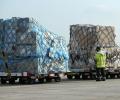
However, as of now, container availability has not been seen as an issue as adequate empties are available. The Red Sea strait is vital for 30 per cent of global container traffic and 12 per cent of global trade.

A notification of the revised Schedule M rules by the Ministry of Health and Family Welfare has elicited mixed responses from the pharma sector and industry observers. While the industry has welcomed the revision of rules, several analysts said that implementation and compliance can become a challenge for smaller pharmaceutical companies. The Schedule M of the Drugs and Cosmetics Rules specifies the good manufacturing practices (GMPs), which aim to ensure quality of drugs made in the country.

India's exports to Iran have been falling over the last one year, amid decline in rupee reserves of the West Asian economy. Going ahead, the possibility of augmenting exports to Iran may not be easy for India, considering the geopolitical tensions - Russia-Ukraine and Israel-Hamas conflicts - and the West Asian country's support for Russia and Hamas, people aware of the matter said. Exports to Iran saw a downward spiral since November last year.

Larger hospitals are not worried about a spike in cases, as they are now accustomed to converting ICUs and general wards into negative pressure zones or isolation rooms. For smaller hospitals, the task is tedious.

Pharmaceuticals major Mankind Pharma reported a 21 per cent year-on-year (Y-o-Y) increase in net profit, with revenue rising by 12 per cent Y-o-Y in the second quarter of the financial year 2024 (Q2FY24) in a regulatory filing lrecently.
The Centre is unlikely to offer new direct tax incentives for units operating in special economic zones (SEZs) and may instead allow the grandfathering of previous exemptions that such units were entitled to, according to proposed amendments to the SEZ Act, 2005, people aware of the matter said. The amendments, proposed by the commerce department, will soon be considered by the Cabinet for approval. This represents a departure from the department's earlier plan to introduce these changes through the Development Enterprises and Services Hubs (DESH) Bill, 2023, which faced strong criticism from the ministry of finance.

AQuity Solutions is a leading tech-enabled clinical documentation, medical coding and revenue integrity solutions provider in the healthcare domain. On the other hand, IKS Health provides administrative, clinical and operational services to clinicians.

Commerce secretary Sunil Barthwal is set to attend a two-day meeting from October 23 at the World Trade Organization (WTO) headquarters in Geneva, that would focus on finding solutions and giving the 'necessary political push' for at least some crucial global trade issues. Next week's meeting comes ahead of the WTO's 13th ministerial conference (MC13), scheduled in Abu Dhabi in February 2024. It will see participation of senior government officials from all WTO member nations.
India's trade ties with Israel have only strengthened in the years after 2019. The total value of trade rose to $10.5 billion on a rolling four-quarter basis in June 2023 from $5.5 billion in the same month in 2019, shows a Business Standard analysis of data from the Centre for Monitoring Indian Economy (CMIE). A rolling four-quarter number provides a comparable figure across different time periods.
The government has decided to hold off introducing the production-linked incentive (PLI) scheme for additional sectors until it verifies the efficacy of existing initiatives. Top government officials have received mixed feedback on the scheme, including insights from the Economic Advisory Council to the Prime Minister, people aware of the matter said. "There are no new PLI schemes in the offing.
 © 2026 Rediff.com - Advertise with us - Disclaimer - Privacy Policy - Sitemap - Feedback - About us - Terms of use - Grievances